
Introduction: Why Business Process Improvement Matters
As businesses in Tanzania continue to grow, operational complexity increases alongside expansion. More customers create more workflows. More employees require stronger coordination. Greater revenue introduces increased financial, operational, and compliance risks.
However, many organizations still rely on outdated systems and workflows designed for a much smaller stage of growth. Over time, these inefficient processes reduce profitability, slow decision-making, increase operational costs, and weaken competitiveness.
This is where Business Process Improvement (BPI) becomes essential.
At Ronalds Tanzania, a modern professional services firm providing Assurance, Audit, Business Advisory, Consulting, Compliance, Tax Advisory, Outsourcing, and Deal Advisory services, we help businesses improve operational efficiency, strengthen governance, and support sustainable growth.
As one of the trusted advisory firms in Tanzania, Ronalds Tanzania supports organizations seeking operational excellence, investor readiness, and stronger financial performance.
What Is Business Process Improvement (BPI)?
Business Process Improvement (BPI) is a structured approach to analyzing, evaluating, and redesigning workflows to improve efficiency, reduce waste, and enhance organizational performance.
Contrary to common perception, BPI is not simply about reducing costs. Instead, it focuses on ensuring that every business process contributes directly to organizational objectives while using resources effectively.
For businesses operating in Tanzania, BPI helps improve:
- Operational efficiency
- Financial reporting accuracy
- Internal controls
- Regulatory compliance
- Customer service delivery
- Decision-making speed
- Risk management frameworks
As organizations scale, effective process management becomes essential for maintaining profitability and operational control.
Businesses increasingly work with experienced business advisory and consulting firms in Tanzania to align operations with long-term strategic goals.
Why Business Process Improvement Is Important in Tanzania
Tanzania’s business environment is becoming more competitive and highly regulated. Organizations must balance growth ambitions with:
- Tax compliance requirements
- Financial reporting obligations
- Regulatory expectations
- Corporate governance standards
- Investor and stakeholder demands
Consequently, inefficient workflows create operational bottlenecks, financial losses, and compliance risks.
Businesses with outdated processes often experience:
- Slow approvals and delayed execution
- Poor coordination between departments
- Increased operational costs
- Weak financial visibility
- Higher error rates
- Reduced audit readiness
This is why many organizations seek support from trusted financial consulting and advisory firms in Tanzania to improve operational efficiency and strengthen governance structures.
The Core Stages of Business Process Improvement
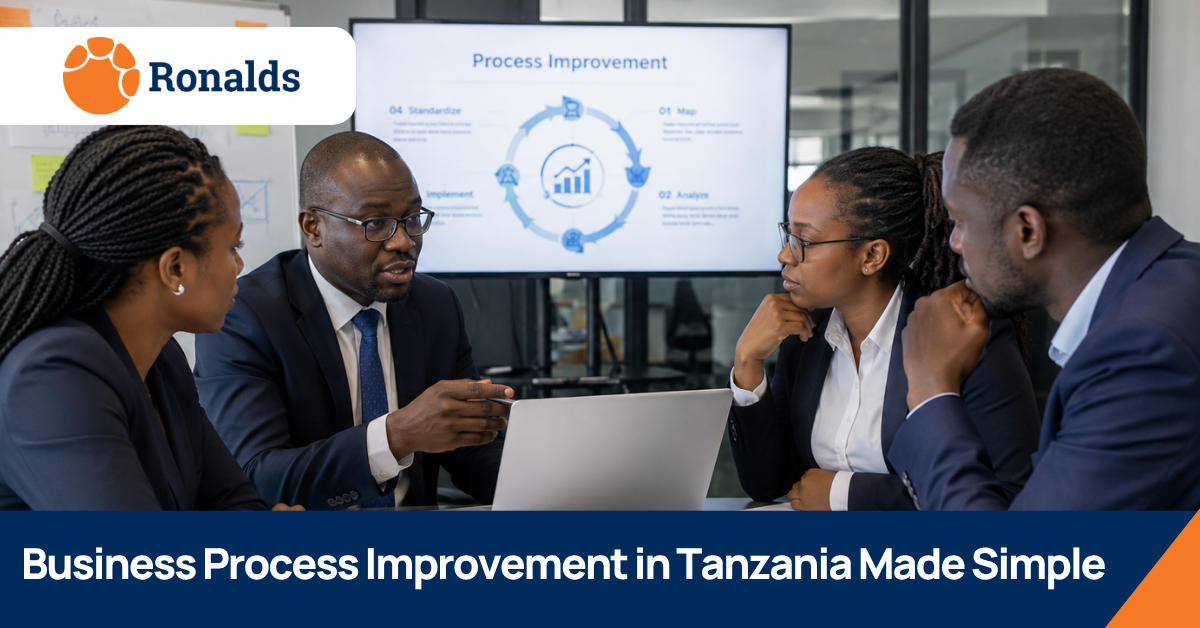
A successful Business Process Improvement engagement typically follows three key stages.
1. Process Mapping
The first stage involves documenting how work actually flows through the organization.
This process helps identify:
- Operational bottlenecks
- Duplicated activities
- Control weaknesses
- Delays and inefficiencies
- Gaps between policy and practice
Process mapping creates visibility into how operations function in reality—not just how they appear in documented procedures.
2. Process Evaluation
Once workflows are mapped, organizations assess them against measurable performance indicators such as:
- Processing time
- Cost per transaction
- Error frequency
- Compliance risks
- Resource utilization
This evaluation helps identify areas where inefficiencies reduce profitability or increase operational risk.
Many businesses also engage experienced audit firms in Tanzania to independently assess financial controls and operational effectiveness.
3. Process Redesign and Implementation
After weaknesses are identified, organizations redesign workflows to improve performance.
Improvements may include:
- Process automation
- Simplified approval structures
- Stronger accountability systems
- Improved reporting frameworks
- Staff training and change management
Importantly, successful implementation requires leadership commitment and continuous monitoring.
Common Operational Inefficiencies in Tanzanian Businesses
Across sectors, several operational inefficiencies consistently appear in growing organizations.
Manual and Undigitized Processes
Many businesses still rely heavily on:
- Spreadsheet-based reconciliations
- Paper-based approvals
- Manual onboarding procedures
These systems create delays, increase errors, and weaken operational visibility.
Organizations increasingly work with experienced outsourcing and accounting firms in Tanzania to modernize operational and financial systems.
Unclear Process Ownership
When accountability is unclear, responsibilities become fragmented and operational tasks fall through the gaps.
Clear ownership improves:
- Decision-making
- Operational accountability
- Workflow consistency
- Internal coordination
Poor Cross-Department Coordination
Misalignment between finance, operations, procurement, compliance, and sales often creates unnecessary friction and execution delays.
Effective Business Process Improvement strengthens collaboration across departments.
Excessive Approval Layers
Over time, organizations often accumulate unnecessary approval stages that slow execution without improving control.
BPI helps simplify governance structures while maintaining proper oversight and risk management.
Weak Performance Measurement
Without measurable performance indicators, organizations struggle to:
- Identify inefficiencies
- Measure productivity
- Evaluate process improvements
This weakens operational visibility and strategic decision-making.
How Business Process Improvement Supports Financial Performance
The financial benefits of Business Process Improvement are significant.
Organizations that improve operational efficiency often achieve:
- Reduced operational costs
- Faster turnaround times
- Lower error rates
- Improved customer satisfaction
- Better compliance readiness
- Increased profitability
Importantly, efficient organizations are also better positioned to:
- Attract investors
- Secure financing
- Improve audit readiness
- Meet regulatory expectations
This is particularly important for organizations engaging with reputable accounting firms in Tanzania, regulators, investors, and financial institutions.
The Link Between Process Improvement, Governance, and Compliance
Strong operational processes support:
- Corporate governance
- Financial reporting accuracy
- Tax compliance
- Internal controls
- Risk management
Organizations with weak operational structures often struggle during:
- External audits
- Tax reviews
- Investor due diligence
- Regulatory inspections
For this reason, many businesses engage trusted tax advisory and compliance consulting firms in Tanzania to strengthen governance and compliance frameworks.
How Ronalds Tanzania Supports Business Process Improvement
At Ronalds Tanzania, we help organizations improve efficiency, strengthen controls, and support sustainable growth through practical advisory solutions tailored to the Tanzanian business environment.
Our services include:
- End-to-end process diagnostics and mapping
- Operational efficiency assessments
- Financial process improvement
- Risk and compliance reviews
- Workflow redesign and optimization
- Change management support
- Post-implementation monitoring frameworks
Through integrated audit and assurance services in Tanzania, business advisory services, tax compliance support, and outsourcing services Tanzania, we help organizations align operations with strategic growth objectives.
As one of the trusted audit firms, accounting firms, advisory firms, and consulting firms in Tanzania, Ronalds Tanzania supports businesses across Tanzania and East Africa seeking:
- Operational resilience
- Investor readiness
- Regulatory compliance
- Sustainable profitability
Conclusion: Operational Efficiency Is a Competitive Advantage
In today’s business environment, operational efficiency is no longer optional—it is a strategic necessity.
Organizations that invest in Business Process Improvement strengthen:
- Financial performance
- Compliance readiness
- Governance structures
- Operational scalability
- Long-term competitiveness
Businesses that continue operating with inefficient processes risk rising costs, delayed execution, and weaker profitability.
With the right advisory support, organizations can transform operational complexity into sustainable growth and stronger business performance.
Ronalds Tanzania remains committed to helping businesses across Tanzania and East Africa build efficient, scalable, and resilient operational frameworks.
Frequently Asked Questions (FAQs)
What is Business Process Improvement (BPI)?
Business Process Improvement is a structured approach to analyzing and redesigning workflows to improve efficiency, reduce waste, and strengthen operational performance.
What are the best audit firms in Tanzania?
The best audit firms in Tanzania provide independent assurance, financial reporting support, risk advisory, and compliance services aligned with local regulations and international standards.
What services do accounting firms in Tanzania provide?
Accounting firms in Tanzania typically provide bookkeeping, financial reporting, payroll support, outsourcing, tax compliance, and advisory services.
Why hire a tax advisory firm in Tanzania?
Tax advisory firms help businesses manage tax compliance, reduce regulatory risks, improve tax efficiency, and navigate Tanzania Revenue Authority requirements.
How do advisory firms help businesses grow?
Advisory firms help organizations improve operational efficiency, strengthen governance, manage risk, optimize processes, and support strategic decision-making.
Why is process improvement important for growing businesses?
As businesses scale, operational complexity increases. Process improvement helps maintain efficiency, reduce costs, improve governance, and support sustainable growth.